EXPLORING ATTIA HOSAIN'S SUNLIGHT ON A BROKEN COLUMN
🟥 ABOUT THE WRITER
Hosain's writing often reflects the complexities of the Muslim aristocracy in Lucknow, where she was born, and the impact of partition on Indian society. She was also an advocate for women's education and empowerment, and her works continue to be celebrated for their insightful and nuanced portrayal of Indian life and history.
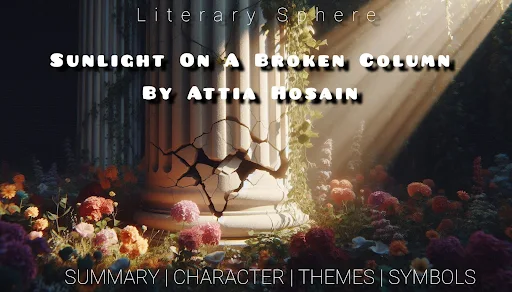
🟥 SUNLIGHT ON A BROKEN COLUMN SUMMARY
"Sunlight on a Broken Column," published in 1961, is a semi-autobiographical novel by Attia Hosain. Set in pre- and post-partition India, the narrative unfolds through the eyes of its protagonist, Laila, and provides a poignant exploration of the social, political, and personal upheavals during this transformative period.
The novel begins in the 1930s in Lucknow, a city known for its rich cultural heritage. Laila, a young orphaned girl of a respectable Muslim family, lives in the ancestral home of her late father, a Taluqdar (landowner). Her life is marked by the rigid traditions and expectations of her aristocratic family, which includes her strict and authoritative grandfather, Baba Jan. The household is a microcosm of the larger societal structures, deeply entrenched in customs and hierarchies.
Laila’s world is closely intertwined with her cousin Zahra, and their lives reflect the differing attitudes towards tradition and modernity. Zahra embodies compliance with societal expectations, while Laila harbors a quiet rebellion against the constraints imposed on her. Despite her privileged upbringing, Laila is acutely aware of the inequalities around her, especially the plight of the less fortunate.
As Laila matures, the political landscape of India shifts dramatically. The struggle for independence from British rule intensifies, and the movement for Pakistan gains momentum. These historical events are mirrored in the personal transformations of the characters. Laila's uncle, Hamid, and her cousin, Asad, become involved in the nationalist struggle, reflecting the broader nationalistic fervor.
A significant turning point in Laila’s life occurs with the death of her grandfather. This event not only marks the end of an era but also signifies a loosening of the strictures that had governed her life. Laila seizes this moment to pursue her education, a desire she had long harbored but was previously unable to fulfill due to familial obligations.
Laila’s quest for self-determination is further complicated by her relationships. She falls in love with Ameer, a progressive-minded young man. Their love challenges the societal norms and expectations of their time, leading to conflicts with her family. Laila’s decision to marry Ameer without her family's consent marks a bold assertion of her independence and a significant break from tradition.
The partition of India in 1947 brings about seismic changes, not only in the political landscape but also in the lives of the characters. The communal violence and mass displacements that accompany partition are starkly portrayed in the novel. Laila’s family is deeply affected, with members scattered and lives irrevocably altered. The ancestral home, once a symbol of stability and heritage, becomes a haunting reminder of a lost past.
In the post-partition period, Laila returns to her family home, now in ruins, symbolizing the brokenness of the world she once knew. Yet, there is a glimmer of hope as she reflects on her journey and the choices she has made. Her personal growth and resilience amidst the chaos highlight the broader themes of the novel: the struggle for identity, the clash between tradition and modernity, and the enduring quest for personal freedom.
"Sunlight on a Broken Column" is a richly layered narrative that captures the complexities of a society in transition. Hosain's evocative prose and keen observations bring to life the dilemmas faced by individuals caught between the demands of tradition and the allure of modernity. The novel remains a poignant exploration of personal and political upheavals, resonating with readers for its timeless themes and deeply human characters.
🟥 CHARACTER LIST OF SUNLIGHT ON A BROKEN COLUMN
1. Laila: The protagonist of the novel, Laila is an orphaned girl raised by her extended family in a wealthy, aristocratic household. She is intelligent, sensitive, and observant, navigating the complexities of tradition and modernity as she matures.
2. Baba Jan: Laila’s grandfather, the patriarch of the family. He is a strict and conservative figure who upholds traditional values and exercises considerable control over the household.
3. Aunt Abida: Laila’s aunt, who takes on a motherly role in her life. She is compassionate and caring but also adheres to traditional norms and expectations.
4. Aunt Majida: Another of Laila’s aunts, she represents the more traditional and conservative elements of the family. She is less sympathetic to Laila’s desires for independence.
5. Zahra: Laila’s cousin and close confidante. Zahra is more rebellious and outspoken than Laila, often challenging family expectations and norms.
6. Kemal: Laila’s cousin, who is progressive and supports the idea of change and modernity. He becomes an important influence on Laila, encouraging her to pursue her own path.
7. Asad: Laila’s love interest, a young man involved in the nationalist movement. He represents the new India that is emerging, challenging colonial rule and traditional structures.
8. Saleem: Another cousin of Laila, who is more aligned with the conservative views of the family. He contrasts with Kemal in his adherence to tradition.
9. Uncle Hamid: Laila’s uncle, who plays a significant role in her upbringing. He is a more moderate figure, balancing traditional values with a degree of openness to change.
10. Sita: A friend of Laila’s, who comes from a different cultural and religious background. Her friendship with Laila highlights the communal harmony and the divisions that exist in Indian society.
11. Aunt Saira: A more liberal and modern aunt who influences Laila’s thinking and encourages her independence. She is a contrast to Aunt Majida in her outlook and approach to life.
12. Uncle Mohsin: Another uncle who represents the more liberal and progressive side of the family. He supports Laila's education and growth.
These characters collectively represent the spectrum of views and attitudes in the society portrayed in the novel, reflecting the tensions between tradition and modernity, personal desires, and societal expectations.
🟥 THEMES OF SUNLIGHT ON A BROKEN COLUMN
Tension Between Tradition and Modernity
The novel explores the clash between traditional values and modern ideals through Laila’s experiences. Her family, particularly her grandfather Baba Jan, represents conservative traditions, while Laila's desire for independence and modernity reflects a new way of thinking. This generational conflict highlights the broader societal struggle between old norms and emerging changes.
This theme is reflected in Laila’s internal conflict and her interactions with her family.
Quote: “The old ways seemed to be closing in on me, the more I tried to find my own path. I felt like a bird in a cage, longing to fly but bound by invisible bars.”
Impact of Political Upheaval
Set against the backdrop of India’s independence movement and the partition, the novel illustrates how political events shape personal lives. Laila’s awareness of the nationalist cause and her relationship with Asad underscore the intersection of personal and political struggles, reflecting how historical events influence individual choices and relationships.
The novel illustrates how political events shape personal lives through Laila’s experiences with the nationalist movement.
Quote: “As the political winds howled outside, the walls of our home seemed to tremble. I could feel the pull of a new world struggling to be born, even as we clung to the old.”
Search for Self-Identity
Laila’s journey is a quest for self-discovery amidst conflicting expectations from her family and society. Her personal growth involves reconciling her modern aspirations with traditional values, mirroring the broader identity crisis faced by Indian society during the partition era.
Laila’s journey towards self-discovery is a key focus, reflecting the broader quest for identity during a period of change.
Quote: “Who am I in this shifting world? I stand at the crossroads of tradition and change, trying to piece together the fragments of my own identity.”
Gender Roles and Women’s Position
The novel critically examines the limitations placed on women in Laila’s society. It contrasts progressive views, represented by characters like Aunt Saira, with traditional constraints imposed on women. Laila’s struggles highlight the challenges of navigating gender roles and aspirations within a conservative framework.
The limitations placed on women and the varying attitudes towards gender roles are explored through Laila’s interactions with her family.
Quote: “Everywhere I looked, I saw the heavy hand of tradition holding us back. The dreams I dared to dream seemed so out of reach in a world that demanded we remain silent.”
Social Change
Laila’s experiences reflect the broader social transformations occurring in India. The decline of feudal structures and the rise of new social and political movements create a sense of uncertainty and adaptation. The novel portrays how individuals and families respond to and resist these changes.
Laila’s experiences reflect the broader social transformations in India during the novel’s setting.
Quote: “The world outside was changing faster than we could adapt. The old ways crumbled, and we were left to navigate a new and uncertain path.”
Family and Familial Duty
The dynamics of family relationships and obligations are central to Laila’s personal development. The tension between familial expectations and individual desires creates internal and external conflicts. The novel examines the balance between loyalty to family and personal fulfillment.
The tension between familial expectations and personal desires is a recurring theme in Laila’s life.
Quote: “Family duty is a heavy burden, and every choice I make seems to be weighed against the scales of obligation and personal happiness.”
Cultural Heritage and Preservation
The theme of cultural heritage is explored through Laila’s family, representing a rich cultural tradition amidst societal changes. The novel reflects on the challenges of preserving cultural traditions while adapting to modern realities, mirroring Laila’s own struggles with her heritage.
The struggle to preserve cultural heritage amidst changing times is a significant aspect of the novel.
Quote: “Our traditions seemed to be slipping away like grains of sand through my fingers. I feared that in the rush to embrace the new, we might lose the essence of who we were.”
Love and Relationships
Laila’s romantic and personal relationships reveal the complexities of love within the context of societal expectations and political unrest. Her interactions with characters like Asad illustrate how personal relationships are influenced by broader social and political forces.
are influenced by societal and political forces.
Quote: “Love, in this tumultuous time, feels like a fragile thread, easily snapped by the pressures of a world in upheaval. Yet it is this love that offers a glimpse of hope amid the chaos.”
VISIT :LITERARY SPHERE FOR MORE
Comments
Post a Comment